
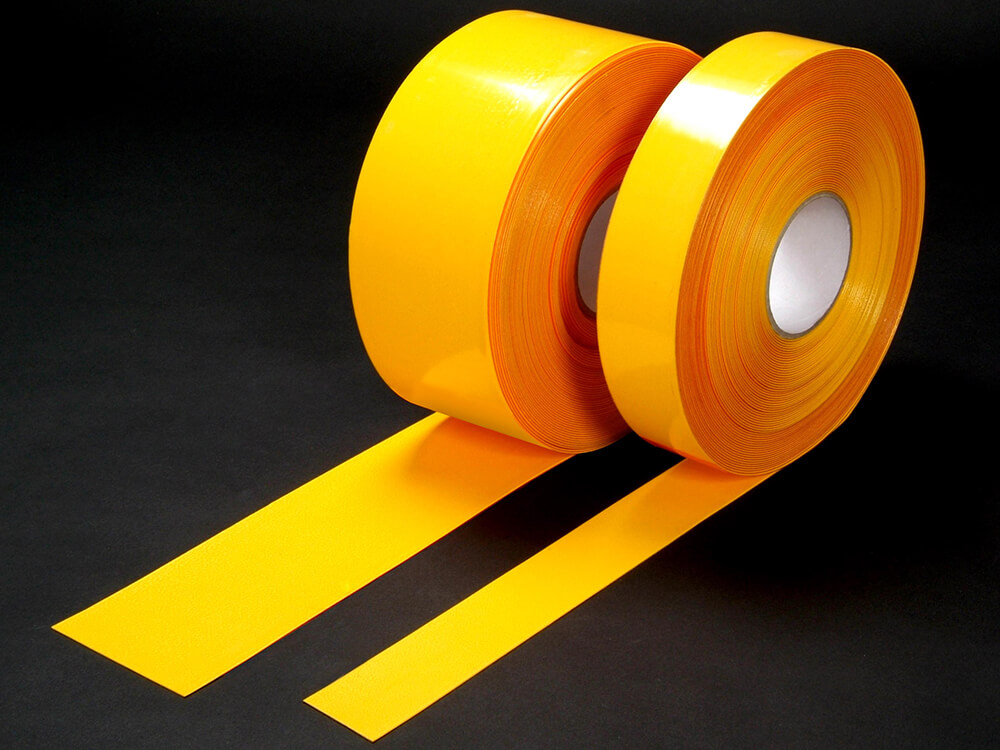
Industrial floor marking tape may be exposed to substantial temperature changes depending on where it is installed. Warehouses, factories, loading areas and logistics facilities can become considerably warmer during summer, while sites in hotter regions may experience elevated temperatures for extended periods.
PermaStripe was developed as a durable line marking system for industrial environments. Because the product carries a conditional three-year guarantee, its performance must be considered across a range of operating conditions. The original high-temperature testing project was prompted partly by PermaStripe’s expansion into Middle Eastern markets and the need to assess the material for hotter working environments.
Understanding how temperature affects tape is important when selecting any self-adhesive product. However, it is also essential to distinguish between industrial floor tape, specialist heat resistant tape, high temperature tape used during manufacturing processes and heat resistant double sided tape designed for bonding components.
Does Temperature Affect Tape?
Yes, temperature can affect both the adhesive and the backing material of a tape.
High temperatures may cause some adhesives to soften, reducing their resistance to movement or increasing the risk of adhesive flow. Extreme cold can have the opposite effect, making an adhesive harder and less able to conform closely to the surface. Tape manufacturers therefore select different adhesive chemistries according to the temperature, surface and type of exposure expected during use.
Temperature can affect tape during two separate stages:
- Application temperature – the temperature of the floor, tape and surrounding environment when the tape is installed.
- Service temperature – the temperatures the tape experiences after it has been applied.
A tape may tolerate a relatively demanding service environment but still need to be installed within a narrower temperature range. This is because pressure-sensitive adhesive must initially flow into the microscopic profile of the surface to create sufficient contact.
Surface condition remains equally important. PermaStripe should be applied to a clean, dry surface using firm pressure. Once application is complete, the area can be returned to use immediately without waiting for paint or resin to dry.
Why Was PermaStripe Subjected to High-Temperature Testing?
PermaStripe is used in warehouses, manufacturing plants and other industrial facilities around the world. Conditions can vary substantially between locations, so performance cannot be assessed only under normal indoor UK temperatures.
The high-temperature testing was intended to provide greater confidence in how the material would perform when exposed to hotter ambient conditions. This was particularly relevant as PermaStripe increased its activity in Middle Eastern markets.
The test was not intended to reposition PermaStripe as a specialist furnace, soldering or powder-coating tape. Instead, it examined an industrial floor marking product intended for workplaces where the surrounding temperature may rise above standard room conditions.
PermaStripe has several construction features intended to support long-term industrial use:
- A thick, homogeneous PVC construction
- Colour running throughout the material
- Bevelled edges
- A strong pressure-sensitive adhesive
- An embossed surface
- A conditional three-year guarantee
The homogeneous construction means that surface abrasion does not immediately remove a printed colour layer, while the bevelled edges reduce the exposed shoulder presented to passing traffic. The current PermaStripe product specification states a total thickness of approximately 1,300 microns.
At What Temperature Does Tape Melt?
There is no single temperature at which all tape melts.
Adhesive tapes are made from different combinations of backing materials, adhesives, primers, coatings and release liners. These components do not necessarily melt at the same temperature. In many cases, the adhesive may soften or flow before the backing begins to deform. Other materials may shrink, become brittle or lose strength rather than melting cleanly.
The temperature capability of commercial tapes varies considerably. For example, some specialist masking tapes are designed for processes around 150°C, while nylon and polyester tapes may tolerate short exposure near 204°C. Certain polyimide tapes are designed for temporary exposure up to approximately 260°C.
These figures do not mean that one tape can automatically replace another. Duration, load, substrate, adhesive type and environmental conditions all influence performance.
When assessing a tape, businesses should therefore consider:
- Maximum continuous temperature
- Maximum short-term temperature
- Exposure duration
- Whether the tape is carrying a mechanical load
- The type of surface
- Contact with chemicals or moisture
- Whether clean removal is required
- Whether the tape is intended for masking, bonding or floor marking
A stated temperature limit should always be interpreted alongside the manufacturer’s technical data rather than treated as a universal melting point.
What Is Heat Resistant Tape Used For?
The term heat resistant tape covers several specialist product categories.
Common applications include:
- Masking components during powder coating
- Protecting surfaces during paint-baking processes
- Electrical and electronic insulation
- Printed circuit board manufacturing
- Solder reflow processes
- Automotive under-bonnet applications
- Heat shielding
- Composite manufacturing
- Splicing films or foils
- Holding components temporarily during thermal processing
A specialist high temperature tape may use a polyimide, polyester, foil, nylon or glass-cloth backing. Silicone or specially formulated acrylic adhesives are frequently used where the product must remain stable or remove cleanly after exposure to heat.
For example, polyimide high-temperature masking tapes are commonly used for powder coating, anodising, electroplating and protecting electronics during high-temperature processing.
These applications differ substantially from floor marking. A masking tape may need to survive extreme heat for a short manufacturing cycle but may not be designed to withstand repeated forklift traffic. Conversely, industrial floor tape may be constructed for mechanical wear, visibility and long-term adhesion but should not be assumed suitable for ovens or direct contact with very hot machinery.
What Is Heat Resistant Double Sided Tape?
Heat resistant double sided tape is designed to bond two surfaces together while tolerating elevated processing or operating temperatures.
Applications can include:
- Automotive components
- Electronic assemblies
- Heat sinks
- Printed circuit boards
- Nameplates and graphic overlays
- Appliance components
- Industrial laminating
- Components exposed to soldering or thermal cycling
Some high-temperature adhesive transfer tapes are thermoplastic, meaning they become softer as the temperature rises and firmer as it falls. Their adhesion strength can therefore reduce as operating temperature increases, even though the product has been formulated to tolerate much greater heat than a standard adhesive tape.
Other heat-activated bonding films remain non-tacky at room temperature and form a permanent structural bond only after controlled heat and pressure are applied.
PermaStripe is not a heat resistant double sided tape. It is a single-sided, self-adhesive floor marking material. Including this distinction is important because the products serve entirely different functions.
Installing Floor Marking Tape in Hot Environments
Even where a tape has demonstrated good resistance to elevated temperatures, correct installation remains essential.
Before applying PermaStripe:
- Confirm that the floor is structurally sound.
- Remove dust, grease, oil and cleaning residue.
- Allow the surface to dry completely.
- Check the floor and tape are within a suitable application-temperature range.
- Mark out the required route before removing the liner.
- Apply the tape without stretching it.
- Use firm, consistent pressure across the full width.
- Inspect edges and joins after installation.
Testing a sample is advisable where a facility has unusually high temperatures, significant thermal cycling, contaminated flooring or demanding cleaning procedures. PermaStripe offers samples so organisations can assess adhesion, appearance and surface compatibility in their own environment before committing to a larger installation.
Temperature is only one part of the specification. Forklift movements, items being dragged across the marking, floor coatings, cleaning chemicals and surface contamination may all affect service life.
Selecting the Correct Tape for the Temperature
The most suitable tape depends on the application rather than the keyword used to describe it.
Choose a specialist heat resistant tape where the material will be exposed to paint ovens, powder coating, soldering or direct process heat. Consider heat resistant double sided tape where two components must remain bonded at elevated temperatures.
For warehouse routes, pedestrian walkways, production zones and industrial aisles, use a floor marking product engineered for visibility, mechanical durability and adhesion to suitable flooring.
PermaStripe’s high-temperature testing was part of establishing confidence in the product for industrial locations with hotter ambient conditions. It does not remove the need to review the specific environment, prepare the surface correctly and test the material where conditions are unusual.
For facilities operating in demanding climates, contact PermaStripe with details of the floor surface, expected temperature range, traffic levels and cleaning process. The team can recommend the most appropriate floor marking product and provide samples for an application trial.